Diverse robot teams
Two-, three-, four-, and eight-arm tasks span homogeneous and heterogeneous teams, with explicit roles and instructions.
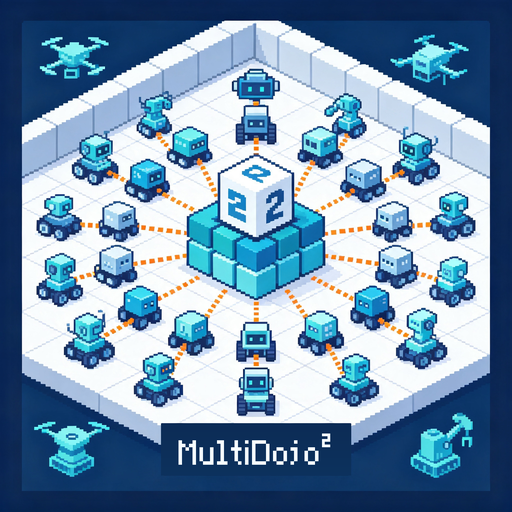 MultiDojo²COOPERATE. EVALUATE. EVOLVE.
THE WORLD’S FIRST SELF-EVOLVING HETEROGENEOUS MULTI-ROBOT LEADERBOARD
The World's First Self-Evolving Leaderboard for Heterogeneous Multi-Robot Collaboration.
Multi-view training, randomized evaluation, and failure diagnosis guide the next round of learning.
From fan assembly to parallel manipulation: collaboration across homogeneous, heterogeneous, and humanoid robot teams.
Homogeneous & heterogeneous teams
Reviewed training demonstrations
Diagnose failures. Guide the next round.
Every arm’s first-person + third-person views
01 / THE BENCHMARK
From two-arm handovers to eight-arm parallel tasks,
evaluate the outcome and the collaboration behind it.
Two-, three-, four-, and eight-arm tasks span homogeneous and heterogeneous teams, with explicit roles and instructions.
Vary object positions, destinations, appearance, and initial states within task constraints. Evaluate collaboration against consistent physical criteria.
Task-specific checks verify grasping, placement, support, stability, and collision constraints. Execution evidence supports reproducible scoring and RSI diagnosis.
Loading task demonstrations…
Demonstrations on natural tabletops. Scene variations preserve task instructions and follow a shared scoring protocol.
02 / EVIDENCE-DRIVEN IMPROVEMENT
RSI identifies opportunities for improvement
and turns diagnosis into specific training scenarios.
Aligned observations and actions
Multi-arm, multi-view data
Randomized environments and initial states
Consistent physical validation
RSI assessment
Failure analysis and recommendations
Specify objects, positions, and roles
Export candidate training scenarios
Train on identified weaknesses
Retest in independent scenes
RSI / REPLAY → EXPLANATION → CURRICULUM
Link replay timestamps to robot actions and object states to identify the operation stages that need improvement. Recommendations specify tasks, position ranges, motion constraints, and acceptance criteria for candidate scenarios.
Candidate scenes enter targeted training after simulation and data validation. Improvements are then measured under the same evaluation protocol.
03 / START EXPLORING
20+ tasks and 2,000+ trajectories, with synchronized first-person views for every arm, third-person views, native observations, and actions. Training data is being progressively released on Hugging Face.
Download training data on Hugging Face ↗Explore data formats and usage ↗Randomized trials, task scores, and execution replays follow a shared protocol for policy comparison, reproducible review, and continued improvement.
Open the evaluation workspace ↗Task definitions, data formats, evaluation protocols, and the RSI workflow provide a clear starting point for collaboration research and reproducible experiments.
Explore the project ↗Research and usage guide ↗View on GitHub ↗MultiDojo² connects multi-view demonstrations, randomized evaluation, and failure-driven training for homogeneous and heterogeneous teams. Research directions include handovers, spatial coordination, timing, and translating execution evidence into specific training tasks.